NRF 2026: The End of ‘Browsing’ and The Rise of Agentic Commerce
From Google’s Universal Commerce Protocol to the practical rise of Agentic AI, this is what our team learned in NYC this week.
January 15, 2026
•
5 mins read
•
We called it last year and NRF just affirmed it: 2025 was the year we experimented with AI, 2026 is the year we’re handing it the keys.
This past week at NRF in New York City, the atmosphere was distinctly different from years past. The theoretical panels about "the future of retail" were replaced by practical, aggressive deployments that aim to solve immediate friction points.
The IM Digital team was on the floor, and we’ve distilled the chaos of the "Big Show" into the four critical trends and concepts that matter the most for your business.
1. The Game Changer: Google & Shopify’s Universal Commerce Protocol (UCP)
This was the earthquake of the week. For the last decade, e-commerce has been about bringing people to a website. The future is about bringing products to AI agents, so people get the products they're searching for a lot faster.
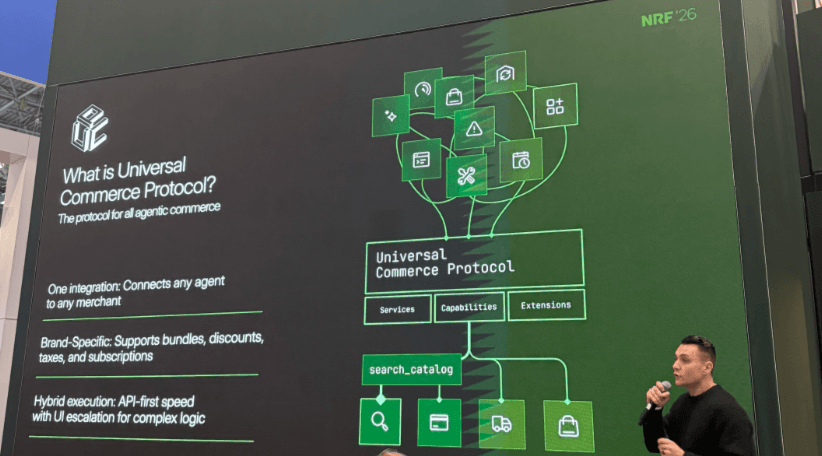
Google, Shopify, Walmart, and others announced the Universal Commerce Protocol (UCP).
What is it? UCP is an open-source standard that allows AI agents (like Google’s Gemini) to seamlessly interact with a retailer’s backend. It standardizes how an AI reads inventory, applies discount codes, and processes payments. UCP also handles loyalty credentials, subscription billing cadences, and final sale terms.
Why it matters:
- The "Broken Link" Fix: Previously, an AI could recommend a sweater, but buying it required a clumsy handoff to a website. UCP allows agents (in Google Search, Gemini, and now Microsoft Copilot) to execute the checkout natively.
- The "Agentic Plan" Loophole: Shopify launched a new "Agentic Plan." This allows brands not on Shopify (i.e., if you are on Salesforce or Adobe) to still list products in the Shopify Catalog and sell through AI channels.
What You Need to Do: Whether you are on Shopify or a custom stack, you need to assess if your API layer is UCP-compliant. If your store can't "speak" this protocol, you risk being invisible to the next generation of AI shoppers.
2. From "Generative" to "Agentic" AI
This is another evolution in language and thinking we’ve been talking about at IM Digital. But it’s a phrase you’ll hear everywhere this year: Agentic AI.
Generative AI (think ChatGPT in 2024) creates content. Agentic AI works. At NRF, we saw this in action across the board:
- Marketing & Sales: We saw Google's new "Direct Offers" pilot, where merchants can present exclusive deals directly inside an AI conversation when high purchase intent is detected.
- Supply Chain: Agents that autonomously negotiate re-orders with suppliers based on pre-set budget rules when stock gets low.
- Customer Experience: Google’s Gemini Enterprise for CX showed off capabilities where an agent can plan a customer's entire weekly meal plan and add all necessary ingredients to a cart in one command.
3. Unified Commerce is Finally…Unified
"Omnichannel" is dead; long live Unified Commerce. The tolerance for data latency is gone. Because Agentic AI moves instantly, it cannot rely on inventory data that is updated once a day.
We saw a massive resurgence in physical tracking tech, specifically RFID overhead tracking claiming 99% inventory accuracy. If an AI agent sells an item online that a customer is currently holding in their hand in-store, the experience breaks.
What You Need to Know: Unified Commerce makes 2026 the year of aggressive data hygiene.
4. Circular Retail as a Profit Center
Sustainability has moved from the marketing department to the CFO’s office. The focus at NRF was on reducing the cost of returns through "Resale as a Service" (RaaS).
New tech stacks are making it easier for retailers to instantly divert returns to resale channels rather than liquidation or landfills. We also saw dynamic AI discounting, in which a customer is offered a partial refund to keep an item with a minor defect rather than returning it, saving shipping costs for everyone.
The IM Digital POV
The message from NRF 2026 is clear: The "walled garden" era of shopping is ending. Barriers are being broken. Customers AND brands stand to win big.
Whether it’s drones delivering packages in Houston (thanks to the new Wing x Walmart expansion) or AI agents buying groceries for your customers, commerce experiences will be fluid and decentralized.
But, is your commerce speaking the same language as agents?
If not, you know where to find us.
Constante Quirino is the Director of Marketing for IM Digital. Having worked with leading brands and retailers across CPG, wellness, fashion, furniture, and interior design, Constante brings a diverse background in branding, merchandising, and search engine optimization (SEO) to every project.
FOLLOW US